Best Metal Roofing Screws
Key Takeaways
- Fasteners are a tiny fraction of the total cost, yet they’re often the first component to cause leaks if selected or installed incorrectly.
- For wood substrates, #10 Hi-Lo is the everyday workhorse; step up to #12 for oriented strand board (OSB) and other engineered wood, and #14 for replacements or high-wind retrofits.
- For steel purlins, choose self-drilling metal screws with a TEK point that matches your steel thickness.
- Ethylene propylene diene monomer (EPDM) washer screws form a watertight seal. Over-tightening or driving at an angle ruins that seal and leads to leaks.
- Never replace a failed #10 with another #10. Move up to a diameter a full size larger (#12 or #14) so the threads bite fresh material.
- Always match screw coating to the environment and panel metal to prevent galvanic corrosion, especially with aluminum panels.
- Plan spacing ahead of time. Panel ends need tighter patterns than the field, and high-wind zones should follow the American Society of Civil Engineers’ seven requirements (ASCE-7).
Choosing the right metal roofing screws isn’t glamorous, but it’s what keeps panels anchored and roofs dry during extreme weather. At Supply Maverick, the e-commerce division of Mid-Michigan Metal Sales, we stock premium, hard-to-find fasteners and specialized components that DIYers ask for and pros trust. This guide breaks down metal-to-wood and metal-to-metal screws, ethylene propylene diene monomer (EPDM) washers, sizing and spacing, and installation mistakes that cause leaks. Most orders placed before 12 p.m. EST ship the same day, so you can keep your project moving.
Why the Right Metal Roofing Screw Makes All the Difference
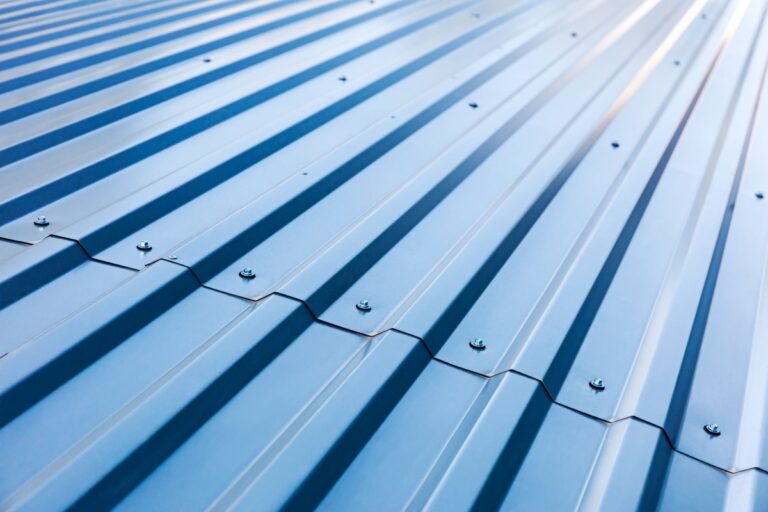
Fasteners account for less than 1% of your installed roof cost, yet improperly fastened screws are a leading cause of metal roof leaks. Over-tightening crushes the EPDM washer beyond its elastic limit, splitting the edges and causing the seal to fail for good. Driving at an angle keeps the washer from seating flat, leaving a capillary path where water wicks under the washer. Spend a few minutes choosing the right fastener (and installing it correctly), and you’ll prevent callbacks, leaks, and panel damage. For a full list of what to watch out for, see our guide on common metal roofing screw mistakes.
The Best Metal-to-Wood Roofing Screws
Metal-to-wood roofing screws are suitable for residential roofs, post-frame buildings, barns, and garages with plywood, OSB, or dimensional lumber purlins. Look for self-piercing or self-drilling points and Hi-Lo threads to improve pull-out strength and long-term hold.
#10 Hi-Lo LoGrip Roofing/Siding Screw (Supply Maverick’s Featured Pick)
Our #10 Hi-Lo LoGrip Roofing/Siding Screw is a high-quality metal-to-wood fastener with a self-piercing point, Hi-Lo thread for strong bite, and a bonded EPDM washer under a metal cap for long-term sealing. It’s offered in multiple lengths with color-matched heads to blend with painted panels.
- Best for: residential and agricultural panels into plywood or dimensional lumber.
- Why it stands out: Hi-Lo threads increase pull-out resistance and help reduce long-term back-out.
- Sizes: common lengths from 1″ to 2″ to cover flats and corrugated ribs.
- Pro tip: fastening through 1/2″ corrugated often calls for about 1.5″ so you still penetrate at least 1″ into the wood.
Need a broader view of wood fasteners? Browse our full range of metal roofing fasteners at Supply Maverick.
#10 ProCap Stainless Steel Cap Metal-to-Wood Fastener (Premium Coastal Pick)
For coastal and high-exposure environments, our #10 ProC ap Stainless Steel Cap Metal-to-Wood Fastener adds a stainless cap that shields the EPDM washer from ultraviolet (UV) light and salt spray. It’s a premium choice for aluminum-zinc-coated steel or painted steel panels in seaside climates and 30+ year roof systems.
- Best for: coastal zones, high-UV roofs, and long-lifespan systems.
- Why it’s premium: stainless cap plus bonded EPDM deliver strong corrosion and UV resistance.
- Substrates: plywood, OSB, or dimensional lumber.
#12 TuffGrip Metal-to-OSB Fastener (Best for Engineered Wood Decks)
OSB and other engineered wood products don’t hold fine threads well. The #12 TuffGrip Metal-to-OSB Fastener uses a larger diameter and a coarser thread pitch so it won’t strip under wind uplift.
- Best for: OSB and other engineered wood decks or purlins.
- Why step up to #12: larger diameter and coarse threads resist strip-out in OSB.
- Tip: if you’re replacing failed #10s in OSB, jump to a #12 or #14 to bite fresh material.
The Best Metal-to-Metal Roofing Screws
When fastening panels to steel purlins or Z-channels, choose self-drilling metal screws (often labeled TEK) that drill, tap, and fasten in one operation. Matching the TEK point number to your steel thickness keeps the tip from snapping or over-drilling.
#12 MetalGrip Self-Drilling Roofing/Siding Fasteners (Steel-to-Steel)
The #12 MetalGrip Self-Drilling Roofing/Siding Fasteners are engineered for 16-22 gauge purlins. They include EPDM washers for a reliable seal and a drill point that cuts cleanly without walking.
- Best for: standard pre-engineered metal buildings and commercial roofs.
- Steel thickness: typical 16-22 gauge purlins and Z-girts.
- Benefits: consistent drilling, a tight seal, and optional color-matched heads.
#12 MetalGrip T5 Self-Drilling Fasteners (Heavy Structural Steel)
The #12 MetalGrip T5 Self-Drilling Fasteners use a T5 drill point rated for steel up to 1/2″ thick, which is ideal for I-beams, tube steel, and heavy structural connections at accessories or transitions. Do not use for polyvinyl chloride (PVC) or synthetic substrates.
- Best for: heavy structural steel up to 0.500″.
- Why T5: the extended drill flute evacuates chips and helps prevent tip burnout in thick steel.
- Reminder: match the point to the steel and avoid using heavy TEK points on thin purlins.
Understanding TEK Drill Point Numbers: Matching the Point to the Steel
Use the right TEK point to avoid snapped tips (too small for the steel) or stripped threads (too aggressive for thin steel). The guide below shows typical ranges.
| TEK Drill Point | Steel Thickness Range | Typical Application |
| #1 | Up to 14 gauge (0.075″) | Light corrugated panels to thin purlins |
| #2 | 14–12 gauge (0.075″–0.105″) | Standard residential and agricultural steel purlins |
| #3 | 12–10 gauge (0.105″–0.134″) | Commercial purlins and Z-channels |
| #5 | Up to 1/2″ (0.500″) | Heavy structural steel, I-beams, and tube steel |
Browse our full range of metal roofing fasteners to match your thickness and coating needs.
The Best Replacement Screws for Leaking or Backed-Out Metal Roofs
Re-screwing a roof? Don’t drop another #10 into a wallowed-out #10 hole. Step up a full diameter so the threads bite fresh material and restore clamping force.
#12 ReGrip Replacement Screw Metal-to-Wood
The #12 ReGrip Replacement Screw Metal-to-Wood is purpose-built for re-screws. A slightly larger shank and coarse thread lock into wood around a worn #10 hole. A bonded EPDM washer with a metal grommet protects the seal from UV and driver abrasion.
- Use when: original #10s have backed out or lost tension.
- Benefit: immediate upgrade in holding power without enlarging the hole further.
#14 FastGrip Replacement Metal Roofing/Siding EPDM Washered Screws
The #14 FastGrip Replacement Screws handle severely enlarged holes and high-wind retrofits. The oversized diameter and large bonded EPDM washer cover bigger openings and re-establish a tight, watertight clamp.
- Use when: holes are severely wallowed out or in high-wind uplift zones.
- Tip: verify you still have at least 1″ of thread embedment into sound wood.
#12 ReGrip Stainless Steel Replacement Screw (Coastal Repair Pick)
The #12 ReGrip Stainless Steel Replacement Screw is a premium coastal repair option when failure is caused by corrosion, not just mechanical pull-out. It pairs corrosion resistance with the bite you need for older holes.
- Use with: aluminum or coated steel panels in corrosive or coastal environments.
- Reminder: match screw metal to panel metal to prevent galvanic corrosion.
Browse our full range of metal roofing fasteners to find the right replacement screw for your job.
Key Factors to Consider When Choosing Metal Roofing Screws
Screw Coatings and Corrosion Resistance
Choose a coating that matches your environment and panel metal. It’s the simplest way to extend roof life and avoid red rust or white corrosion blooms.
| Coating Type | Corrosion Resistance | Best Application |
| Zinc-Plated | Standard | Inland, low-humidity environments |
| Zinc/Aluminum Alloy Cap | Long-life | Residential, agricultural, most commercial |
| 300-Series Stainless Steel | Premium | Coastal, aluminum panels, chemical exposure |
| 410 Stainless Steel | High, not for aluminum | Steel panels in corrosive environments |
Galvanic corrosion occurs when dissimilar metals come into contact in the presence of moisture. For aluminum panels, use 300-series stainless screws, never 410 stainless. For coated steel panels, zinc/aluminum alloy-capped or 410 stainless are dependable picks depending on exposure.
The EPDM Washer: The Most Overlooked Component
It’s the washer, not the threads, that makes the seal; a bonded EPDM washer, vulcanized to a steel backing, stays put and won’t spin off during installation. EPDM also resists UV and temperature swings far better than neoprene. Always use the correct torque: drive until the EPDM is slightly compressed and fully seated, with no rubber bulging past the metal cap. Over-tighten and the EPDM is crushed flat, permanently compromising the seal; under-tighten and the washer can let in moisture and debris. Keep the driver perpendicular so the washer seats flat without gaps.
Screw Size and Length: Getting the Numbers Right
Pick the diameter and length that match your substrate and panel profile. As a rule, you want at least 1″ of thread penetration into sound wood, or full thread engagement in steel after drilling. Length is measured from the underside of the hex head to the tip, and don’t forget to add rib height when you’re fastening on the crown.
| Panel Type | Rib Height | Minimum Screw Length |
| R-Panel / PBR Panel | Low, fastened in flat | 1″ |
| 1/2″ Corrugated | 1/2″ | 1.5″ |
| 7/8″ Corrugated | 7/8″ | 2″ |
| Standing Seam Clip | N/A, concealed | 1″ pancake head |
For a deeper breakdown on sizing, see our article on How Many Screws Per Sheet of Metal Roofing?
Metal Roofing Screw Spacing: How Many Do You Need?
A practical rule of thumb is about 80 screws per roofing square (100 square feet) for standard installations into wood. Panel ends like eaves, ridges, and endlaps always require tighter patterns than the field.
- Typical field spacing: 12″-18″ on center along purlins or rafters.
- Edge and end zones: tighten to 6″-12″ on center depending on wind exposure.
- High-wind zones: follow the American Society of Civil Engineers’ seven requirements (ASCE-7) and expect tighter spacing at edges and corners, with more fasteners per panel.
- Corrugated panels: fasten in the flats per manufacturer guidance; some systems require additional screws on the crown at sidelaps.
Example: A 30-square roof often falls within the 2,200–2,600 screw range, depending on panel profile, purlin spacing, and wind zone. When in doubt, follow your panel manufacturer’s pattern and consult a qualified local installer.
Three Installation Mistakes That Cause Metal Roof Leaks
Over-Tightening the Screw
This is the most common error. Crushing the EPDM past its elastic limit splits the edges so the seal can’t spring back. Stop driving when the washer is compressed and seated evenly under the metal cap.
Driving Screws at an Angle
Angled screws pinch the washer on one side and lift it on the other, creating a capillary path for water. Keep your driver square to the panel and confirm the washer is sitting flat all around.
Using the Wrong Screw for the Substrate
Wood screws in thick steel can snap or never grab. Fine-thread TEKs into OSB will strip under uplift. Galvanized screws with aluminum panels can trigger galvanic corrosion in just a few seasons. To match the screw to your substrate and panel metal, use the TEK chart and coating table provided above.
Where to Buy the Best Metal Roofing Screws
If you want premium, high-quality fasteners without the hassle, you’re in the right place. Supply Maverick stocks everyday essentials and hard-to-find items like stainless replacement screws, color-matched heads, ProCap stainless-capped wood screws, and MetalGrip T5 heavy-structure fasteners. Most orders placed before 12 p.m. EST ship the same day, and we’re set up for projects big and small. Ask us about our:
- Wholesale pricing and bulk-quantity discounts for contractors and facility teams.
- Net 30 accounts available to qualified B2B buyers.
- Global reach and fast shipping to the US, Canada, Australia, and New Zealand.
Browse our full range of premium metal roofing fasteners and get your order out the door today. Need sizing help before you buy? Reach out with your specific product name or SKU, and our team will be happy to help you choose the right fastener for your panels and environment.