Polycarbonate vs. Metal Snow Guards: Durability, Cost, and Performance Compared
Key Takeaways
- Polycarbonate guards cost less per unit, but they typically need replacing well before a metal roof reaches the end of its service life.
- Stainless steel guards usually last as long as the roof itself, which often makes them the better long-term value despite a higher upfront price tag.
- Climate and snow load should drive the material choice, not just the budget line.
- Pairing the wrong metal against your roof panel can trigger galvanic corrosion, so matching metals correctly matters as much as picking a guard style.
- Powder-coat finishes have closed most of the visual gap between the two materials, so looks rarely have to be the deciding factor anymore.
- Clamp-on metal guards skip roof penetrations entirely, which is worth asking about if a warranty is part of the decision.
Cost and curb appeal are the greatest driving factors for homeowners buying snow guards. This leads many to select polycarbonate over metal regardless of climate or long-term plans. While polycarbonate has its place, those planning to stay in their home for a decade or more will find themselves replacing the units multiple times relative to stainless steel, which can last as long as the roof itself. This ends up negating the original value that made polycarbonate an attractive choice in the first place. Polycarbonate guards also have the advantage of transparency, which metal can’t achieve; however, the advance of powder-coating has allowed for metal guards to blend more seamlessly into the roof. The only thing left to consider is galvanic corrosion, so be sure to match metals appropriately to avoid this issue.
| Material | Typical Lifespan | Upfront Cost | Best For | Attachment Method |
| Polycarbonate | A few winters to roughly a decade, depending on sun exposure | Lower per unit | Light-to-moderate snow load, budget-conscious jobs | Adhesive or mechanical fasteners |
| Stainless steel | Often the life of the roof | Higher per unit | Heavy snow load, long-term ownership | Screws, or clamps on standing seam panels |
Snow Guards Are a Life-Safety Product
A sheet of snow and ice sliding off a metal roof is heavy enough to dent a vehicle, crush a fence line, or seriously injure someone standing below. That’s why snow guards exist, and why the material question deserves more thought than most buying guides give it. Pick wrong, and you’re not just out the cost of the guards. You’re back on a ladder in three winters replacing them, or worse, dealing with the damage they were supposed to prevent.
Polycarbonate and stainless steel both work, and both show up on roofs across the country for good reason. What changes is which one performs best on a specific roof, in a specific climate. Supply Maverick, the e-commerce arm of Mid-Michigan Metal Sales, stocks both options: polycarbonate for lighter-duty jobs and the premium stainless steel Snow Defender line for roofs that need to shed heavier loads winter after winter. The right pick should come down to what follows here, not a guess.
What Polycarbonate Snow Guards Are Made Of and How They Perform
Polycarbonate is the lighter-duty, budget-friendly route in this comparison. Before writing it off or leaning on it by default, it’s worth understanding what it’s actually made of, where it performs well, where it falls short, and why that matters over a roof’s lifetime.
Material and Construction
Polycarbonate snow guards are molded from an ultraviolet (UV)-stabilized plastic resin, the same family of material used in eyewear lenses and machine guarding because of how tough it is for its weight. Quality varies: Guards made from virgin resin hold up noticeably better over time than ones cut from recycled material, even though they can look identical on a shelf. Most polycarbonate guards mount one of two ways: bonded to the panel with a roofing-grade adhesive, or screwed down through pre-drilled holes into the deck below.
Where Polycarbonate Holds Up
Because it isn’t metal, polycarbonate never reacts against a metal roof panel the way two dissimilar metals can. It’s also lightweight, low profile, and often close to invisible from ground level, which matters when a homeowner doesn’t want tabs breaking up the roofline. Per unit, it typically costs less than a stainless equivalent, and adhesive-mount versions are approachable enough for a smaller DIY job where a full mechanical install isn’t in the plan.
Where Polycarbonate Falls Short
Sunlight causes most of the damage over time. Years of ultraviolet exposure gradually yellow the resin and make it brittle, and a brittle guard can snap under a load it once handled easily. Sustained sub-zero cold speeds up that same brittleness. Adhesive-mounted units add a second failure point: if the panel wasn’t cleaned properly or the adhesive didn’t get the cure time it needed, the bond can let go well before the material itself gives out. Polycarbonate still performs well in the right application. The realistic service life, though, usually falls well short of the roof it’s protecting, especially with lower-grade recycled resin.
What Metal Snow Guards Are Made Of and How They Perform
Metal takes a different approach to the same problem, trading a lower sticker price for a longer, more predictable service life. The construction, strengths, limits, and mounting options below cover what’s worth knowing before installing it on a roof with real snow load.
Material and Construction
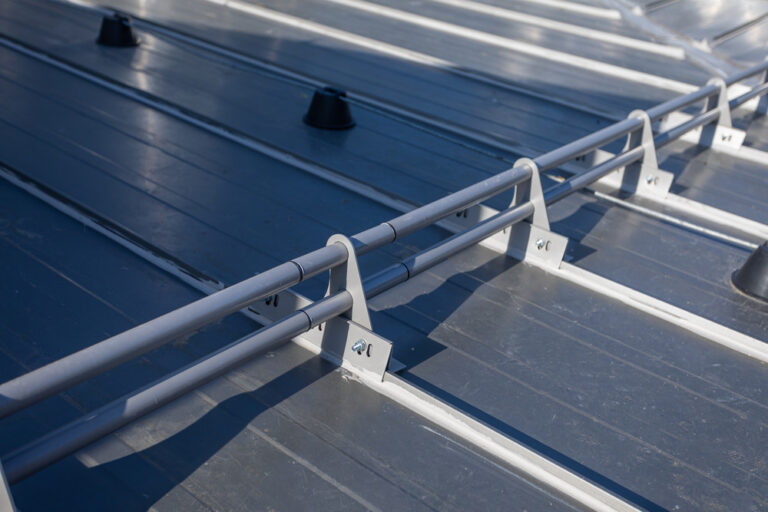
Metal snow guards show up in a handful of common materials, including stainless steel, aluminum, galvanized steel, and painted steel. Styles also vary, including low-profile pad guards, bar-style units, fence-like rail systems for heavier loads, and custom-fabricated pieces for irregular rooflines. Nearly all of them mount mechanically, either through the panel or clamped onto a standing seam, rather than relying on adhesive alone.
Where Metal Holds Up
Properly specified stainless steel doesn’t go brittle in the cold the way plastic can, and it’s rated to last as long as the roof it’s attached to rather than needing a mid-life replacement. Load capacity per guard tends to run higher too, which matters once you’re calculating rows for a heavy snow zone. Powder-coat finishes have also addressed the old complaint that metal guards look like an afterthought bolted onto an otherwise clean roofline.
Where Metal Falls Short
The trade-offs are fewer, but they’re real. Metal costs more per unit than polycarbonate. It also runs the risk of corroding itself; pair the wrong metal against your panel, and you’re looking at galvanic corrosion down the road (which we’ll get into below). There’s also no adhesive-only shortcut available if a job calls for one because metal only mounts mechanically.
Clamp-On vs. Screw-Down Metal Guards
Not all metal guards attach the same way, and the difference matters more on standing seam roofs than almost anywhere else. Screw-down guards penetrate straight through the panel into the deck, delivering strong holding power but raising a fair question about roof warranties.
Anyone concerned about that should run it by the panel manufacturer or a qualified local installer before drilling anything. Clamp-on guards take a different approach, gripping the standing seam itself with set screws and leaving the panel untouched. That’s why clamp-on styles are often the preferred route for standing seam roofs. Exposed-fastener panels don’t have a seam to clamp onto, so this isn’t a universal upgrade; it depends on your panel profile.
Durability Head-to-Head
This is where the two materials really separate. Lifespan and weather resistance tell part of the story, corrosion risk tells the rest, and the gap between the two tends to widen the longer a guard stays in service.
Expected Service Life
Treat every lifespan figure here as a “typically,” because climate, panel type, snow load, and installation quality all move the number. Polycarbonate guards commonly need replacing somewhere between a few winters and about a decade, with UV exposure doing most of the damage. Stainless steel, installed correctly, usually lasts the life of the roof, which on a metal building can run 30 years or more.
Weather and Temperature Resistance
Polycarbonate degrades on a curve. It starts strong, then slowly loses flexibility as ultraviolet light breaks down the resin year over year, until it’s brittle enough to crack under a load it once handled easily. Metal doesn’t follow that curve at all. A correctly gauged stainless guard resists sun exposure indefinitely, and it holds its flexibility through hard freezes that would make a plastic guard snap. Freeze-thaw cycling is where the attachment method is as important as the material: an adhesive bond stressed by repeated expansion and contraction can weaken faster than a mechanically fastened joint.
Corrosion and Galvanic Reaction Risk
Two dissimilar metals in contact, combined with moisture, can set off a galvanic reaction that eats away at whichever metal is less noble in the pairing. On a metal roof, that usually shows up as accelerated rust at the point of contact, and it’s a real reason some installers avoid mismatched metal-on-metal installs. The fix is straightforward: match the guard’s metal to the panel’s, or ensure proper isolation between the two. Polycarbonate sidesteps this entirely, since plastic can’t participate in a galvanic reaction.
What Actually Happens in the Field
Marketing copy aside, one pattern holds up in practice: polycarbonate guards get replaced every few winters as sun exposure catches up with them, while stainless installs tend to be a one-and-done job nobody has to think about again. Durable and permanent are two different claims, and it’s worth knowing which one applies before you buy.
What These Guards Actually Cost Over Time
Sticker price only tells part of the story here. The real comparison shows up once you factor in how often a guard needs replacing and how many a full roof actually requires. It also depends on what happens once an order is large enough to qualify for volume pricing.
Per-Unit and Per-Roof Cost
Polycarbonate guards generally run less per unit than a comparable stainless piece, which is exactly why they’ve stayed popular on budget-sensitive jobs for years. Where the math gets interesting is at the roof level: A full, professionally installed snow guard job typically lands between $1,000 and $4,000 total, with roof size and guard style driving most of that spread. A full installation can call for dozens of guards once rows and spacing are worked out, so a small per-unit gap turns into a real number fast, in either direction.
Cost Per Year of Service
Here’s the napkin math that changes minds. Say a polycarbonate guard costs a few dollars and needs replacing roughly every four winters, while a stainless piece costs more up front but never gets touched again. Run that out across 20 years of ownership and the “budget” option can end up costing more in cumulative material and labor than the guard that looked expensive on day one. This is the number worth running before deciding on price alone, especially on a roof you plan to own for a while.
Installation Cost Considerations
Adhesive-mount polycarbonate can go up marginally faster than a mechanically fastened metal guard, since there’s no drilling involved. That said, labor is usually a smaller share of the total project cost than the guard’s expected lifespan, which is exactly why the cost-per-year framing above matters more than the install-day price tag. Supply Maverick supplies the materials for either route; for the actual install, a qualified local roofing contractor is the right call.
Buying in Volume
A single roof can need two dozen guards or more once you factor in multiple rows and staggered spacing, so unit pricing adds up quickly on a full job. Larger orders qualify for wholesale pricing and bulk quantity discounts, and contractors managing multiple jobs at once can set up a Net 30 account for ordering across projects. Neither path changes which material is right for a given roof, but it’s worth knowing before pricing out a full building.
Snow Load and Spacing in the Real World
Material choice only solves half the problem. How much snow a roof actually sheds, and how the guards get laid out across it, matters just as much as what they’re made of.
How Snow Load Changes the Math
A roof in the upper Midwest or the mountain West is dealing with a different animal than a roof that sees a few light dustings a season. Heavier, wetter snow demands higher-capacity guards and tighter spacing between rows, regardless of which material you land on. Lighter, drier snow zones have more room to go with polycarbonate without pushing its limits. As a rough rule of thumb, higher-load areas often call for one row of guards for roughly every 5 feet of rafter length.
Row Spacing and Panel Compatibility
The general layout logic holds across most installs. The first row typically sits about 24 inches up from the eave; additional rows get staggered rather than lined up in a grid, and rib or seam spacing on the panel dictates exactly where each guard can go. A proper layout from a qualified local installer or engineer is worth getting before ordering, rather than eyeballing it and hoping the count works out. That’s enough to follow a contractor’s layout conversation without turning this section into a full installation walkthrough.
Aesthetics and Roof Compatibility
Polycarbonate still wins the “invisible from the driveway” contest, since clear or lightly tinted material blends into most panel colors without much effort. Metal has made strides through powder-coat finishes that match standard panel colors, so the old argument about clunky metal tabs sticking up off a clean roofline doesn’t hold the way it used to. Panel profile matters here too. Standing seam roofs open up clamp-on options that exposed-fastener panels don’t have, which can affect both the look and the mounting method available to you before cost even enters the conversation.
Which One Should You Choose?
Everything above points toward a fairly simple decision once you match it to the roof in front of you. Here’s how the two options tend to sort themselves out in practice.
Polycarbonate tends to make sense when:
- The roof sees light-to-moderate snow load rather than heavy, wet accumulation.
- Budget is the driving constraint.
- A low, close-to-invisible profile matters more than a 20-year lifespan.
- It’s a smaller DIY-scale job rather than a full commercial install.
Stainless steel tends to make sense when:
- The building sits in a heavy or wet snow climate.
- You’re planning to own or manage the property for the long haul.
- Foot traffic below the eave raises the stakes if a guard ever fails.
- You’d rather install once and then forget about it.
When durability is the deciding factor, Supply Maverick’s premium stainless steel Snow Defender line is built for exactly that scenario, and it’s worth reaching for once the climate and load numbers point toward metal.
Final Thoughts
There’s no universal winner between polycarbonate and metal snow guards. There’s only the right material for a specific roof, climate, snow load, and ownership timeline. Get the spacing and layout right, and either material can do the job. Get the material wrong for the climate, and you’ll likely be back up on that roof sooner than planned.
Whatever the decision, having the right guard in stock and moving matters just as much as the material itself. Most orders placed before 12 p.m. EST ship the same day with Supply Maverick, whether the job site sits in the snowbelt states or up into Canada. Browse the full lineup, including polycarbonate options and the stainless steel Snow Defender line, and order what the roof actually calls for.
Frequently Asked Questions
Do snow guards damage a metal roof or void its warranty?
It depends on the attachment method and the panel manufacturer’s terms. Mechanically fastened guards that penetrate the panel can raise warranty questions with some manufacturers, while clamp-on guards that grip a standing seam avoid penetrations altogether. Check with the panel manufacturer or a qualified local installer before choosing a mounting method on a roof still under warranty.
How long do polycarbonate snow guards actually last?
Somewhere between a few winters and roughly a decade is typical, with ultraviolet exposure and cold-climate brittleness doing most of the damage over time. Guards made from virgin resin generally outlast ones made from recycled material.
Can you mix polycarbonate and metal snow guards on the same roof?
Yes, and it’s a fairly common way to protect a valley, a walkway below the eave, or another isolated area without re-equipping the whole roof. Just apply the same corrosion logic to any metal pieces used, and confirm both types are rated for the load in that section.
What is the difference between snow guards and snow rails?
Snow guards are individual units spaced across the roof in rows, while snow rails (sometimes called snow fences) run continuously along the roofline as a single barrier. Rails generally handle heavier loads across a wider area, while individual guards are more common on smaller roofs or where a lower profile is important.
Do snow guards work on low-slope roofs?
Most manufacturers recommend skipping snow guards on roofs pitched under 3:12. Below that slope, snow tends to clear on its own rather than sliding as a mass, so guards add little benefit and installers often recommend other options instead.
How many snow guards does a typical roof need?
It depends on roof pitch, snow load for the region, and the load rating of the specific guard chosen. A qualified local installer or engineer can run the calculation for a specific roof. Guessing at the count and hoping it holds isn’t worth the risk on a safety product.
References
- Construction Canada. “Snow guards and metal roofs 101.” Construction Canada, November 23, 2015. September 2026.
- Hoffman, Rachel. “5 Types of Snow Guards for Metal Roofs.” Angi, July 9, 2026. September 2026.
- InspectAPedia. “Snow Guard Installation Pattern, Spacing, Location on Roofs.” InspectAPedia. September 2026.