Metal Roofing Screws FAQ: Spacing, Torque, Leaks, and Common Mistakes
Pick the wrong screw, space it wrong, or drive it too tight, and a brand-new metal roof can start leaking within a year. We’re the online arm of Mid-Michigan Metal Sales, a metal building manufacturer, so what follows comes out of real installs and real warranty calls rather than guesswork. Sizing, spacing, torque, leaks, and the mistakes that trip up the most buyers: that’s the order we’ve laid this out in.
Choosing the Right Screw
Choosing the right screw is essential to prevent leaks, resist high winds, and stop premature corrosion that can ruin the entire structure
What size screw do I need for metal roofing?
Diameter and length go hand in hand. Diameter typically runs #9 to #14 depending on the panel and application, while length has to cover the panel’s corrugation depth plus the purlin or decking thickness, with two or three exposed threads left on the back side. For a standard panel-to-wood-purlin job, a #12 hex washer head screw like our TuffGrip metal-to-wood line is a reasonable starting point, though panel gauge and substrate can change that number.
What’s the difference between self-drilling and self-tapping screws?
The main difference is that self-tapping screws require a pre-drilled pilot hole, while self-drilling screws have a built-in drill-bit tip that drills its own hole while fastening.
A self-drilling screw works well for steel-to-steel connections, and our #12 MetalGrip T5 does exactly that: metal-to-metal, self-drilling, no pre-drilling needed. Wood purlins and oriented strand board (OSB) call for a self-tapping screw with a sharp lead-in point.
What does “Tek screw” mean?
Nothing more exotic than “self-drilling screw.” The term has become industry shorthand the way Kleenex has become shorthand for tissues, so a listing that says Tek screw describes the same self-drilling metal roofing fastener covered above, just under a different name.
Should I use stainless steel or galvanized screws?
For most residential and inland jobs, galvanized does the job at a lower cost. Get within a few miles of saltwater, or into any other high-corrosion setting, and the premium option, stainless steel in a 304 or 410 grade, earns its higher price. We carry both, so it really comes down to the site you’re working on rather than what happens to be in stock.
Do metal roofing screws come with the panels, or do I buy them separately?
Separately, almost always. Panel manufacturers sell screws separately, and color-matched screws in particular need to be ordered to match your specific panel color rather than assumed to match. This is where a lot of big-box stores stop short. Specialty items like stitch screws and painted heads in less common colors (the same fasteners that show up across metal roofing and siding installs alike) are exactly the kind of hard-to-find inventory Supply Maverick was built around, backed by bulk and wholesale pricing on full-roof orders whether that order ships across town or to a job site in Canada, Australia, or New Zealand.
Can I match my screw color to my roof panel color?
Yes. Painted-head screws are available in the same standard colors as our structural panels and trims, so a roof and its fasteners can match without any special order. What we can’t do is match a different manufacturer’s paint code, since that falls outside what our own color line covers.
Do I need different or longer screws when installing metal roofing over an existing shingle roof?
Often, yes. Metal panels over 1×4 or 1×6 battens laid on top of old shingles penetrate an extra layer of material, and a screw length that worked fine on new construction can fall short once that layer’s added. Run the same math from the sizing question above (corrugation depth, batten thickness, a few exposed threads) before ordering.
Does the screw drive type matter (hex vs. Phillips)?
A little. Hex washer heads are the roofing standard because they resist cam-out and let a screw gun apply steady, even torque, whereas Phillips-drive roofing screws strip more easily under repeated use. Either way, have the matching bit or socket on hand before you’re up on the roof, not after.
How many screws do I need for my roof?
Roughly 80 screws per roofing square, a square being 100 square feet, is a common industry estimate for exposed-fastener panels, though the manufacturer’s chart for your specific profile is the real source of truth. Order 5 to 10% more than the math calls for, since cuts, dropped screws, and future repairs always chip away at the count. Buying in volume across several jobs is also a good moment to ask about a Net 30 account if you’re a contractor.
Do metal roofing screws expire or go bad in storage?
The steel itself doesn’t degrade sitting on a shelf. What can go wrong is the rubber washer drying out or taking a compression set if a box sits in a hot trailer or direct sun for years before it’s installed. Buy for what the current project needs rather than stockpiling washered screws for one that hasn’t started yet.
Screw Spacing and Placement
Proper screw spacing and placement are essential to ensure structural integrity, prevent water leaks, and resist wind and snow loads
How far apart should metal roofing screws be spaced?
Somewhere between 12 and 24 inches on-center along the purlins covers most panels. Even so, the manufacturer’s screw pattern chart for your specific profile always overrides a general range.
Should screws go in the high rib or the low rib of the panel?
This is not a matter of preference. The manufacturer’s installation sheet decides it, and most exposed-fastener panels call for low-rib placement due to shear; high-rib placement may seemingly make more sense, but they must be in the low part of the panel in order for wind ratings to be covered. Check the sheet before assuming either way.
Do I need extra screws at the sidelaps and panel overlaps?
Every time, yes. Sidelaps and overlaps get their own fastener, often a shorter stitch or lap screw, no matter what the field spacing pattern calls for elsewhere on the panel. That seam is the single most common point where wind uplift and water both find a way in.
Does spacing change for standing seam versus exposed-fastener panels?
Two different fastening systems are at work here, not just two spacing rules. Concealed clips set at wider intervals do the job on standing seam, with no visible penetrations anywhere in the panel field, while exposed-fastener panels need a screw at every rib the manufacturer specifies.
Do I need closer screw spacing in high-wind or coastal areas?
Usually. Local wind-uplift ratings and building codes tend to call for tighter spacing than a manufacturer’s baseline chart in these zones. Get this number from your local code office or a structural engineer rather than guessing.
Is there a standard screw pattern chart I should follow?
There is, and every panel profile has its own version from the manufacturer. Reference lines mark the panel edges, screw lines run along the purlins at set intervals, laps get their own callouts, and corrugations are counted across the panel’s width so nothing lines up by accident. Line your panel width up against the chart and the rest of the pattern tends to follow on its own.
Torque, Tools, and Installation
Torque, tools, and installation methods are critical as they directly control structural integrity, watertight sealing, and long-term roof durability
How tight should metal roofing screws be?
More than any other question, this is the one our team fields daily, and it deserves a direct answer. The rubber washer should compress and bulge just slightly at its edges without flattening out or squeezing past the flange, and it shouldn’t sit loose and untouched either. Go too tight and the seal cracks or flattens; go too loose and water finds the gap. A screw gun with an adjustable clutch, set to stop the instant the washer seats, removes most of the guesswork.
What tool and clutch setting should I use to drive the screws?
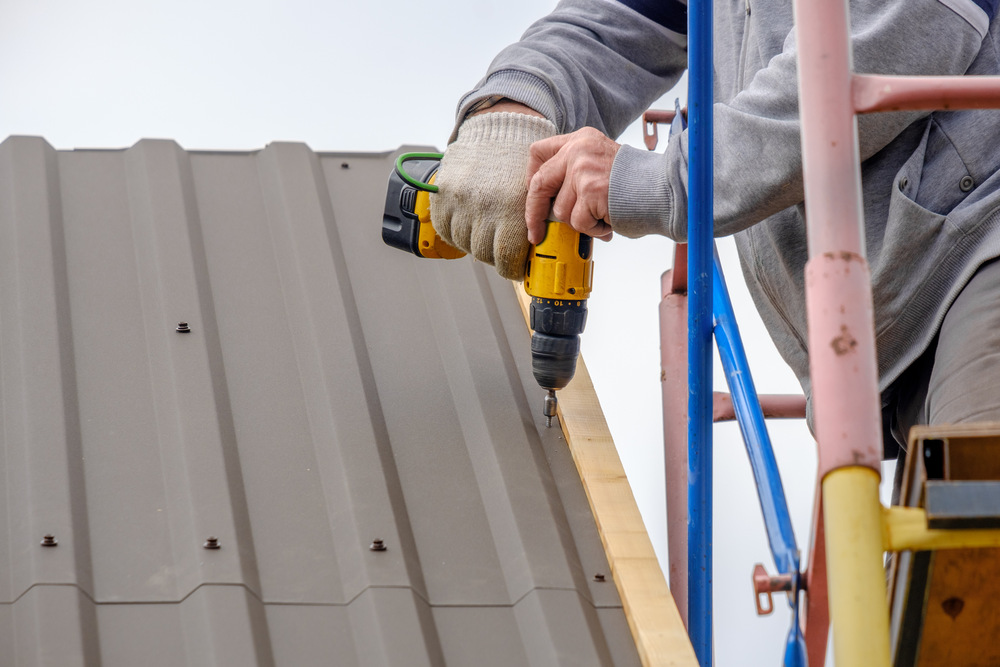
Reach for a screw gun or a drill with an adjustable clutch rather than a fixed-speed impact driver. Set that clutch to stop as soon as the washer compresses, and don’t let it run past that point. Sold separately from the screws themselves, the right hand tool prevents more callbacks than any fastener upgrade ever could.
Should I pre-drill before installing self-drilling screws?
Usually not, since self-drilling points are designed to handle standard-gauge panels without one. Thicker steel and hardened trim are the exception; pre-drilling there keeps the panel from spinning or denting before the threads catch hold.
What angle should the screw be driven at?
Ninety degrees, straight into the panel, every single time. Drive it crooked and the washer can’t compress evenly on all sides, which turns into a quiet cause of leaks that don’t show up until months after the job’s finished.
How do I know if I’ve over-driven or under-driven a screw?
A squashed or split washer edge means it’s over-driven. A washer that’s sitting loose, barely touching the panel, means it’s under-driven. Neither one gets fixed with a quarter-turn; back the screw all the way out and start over with a fresh one.
Can I use an impact driver on metal roofing screws?
Technically, with a clutch-adjustable model. We’d still point a first-time installer toward a straight drill or a dedicated screw gun instead, since the hammering action in an impact driver makes torque harder to hold steady, and steady torque is what a good seal depends on.
Leaks and Washer Failure
Leaks and washer failures are critical issues because they represent the primary breakdown of a roof’s waterproof seal, which directly leads to catastrophic structural damage, mold growth, and expensive building failures
Why do metal roofs leak around the screws?
Four things account for nearly every repeat case: the wrong screw for the job, a screw driven too tight or too loose, a screw driven at an angle, or a washer that’s simply worn out.
Why do screws back out or work loose over time, even if they were installed correctly?
A separate mechanism from over- or under-driving is at play here. Metal panels expand and contract with every temperature swing, and that repeated movement gradually enlarges the screw hole over the years. Swapping in a same-size replacement screw won’t fix a hole enlarged this way; the up-sizing answer below covers what does.
How long do the rubber washers last before they need replacing?
Fifteen to twenty years is a realistic range under normal conditions, with intense UV or coastal heat pushing that number down. A metal-capped washer tends to outlast an exposed rubber one, since it’s shielded from direct sun.
What’s the difference between EPDM and neoprene washers?
EPDM, short for ethylene propylene diene monomer, holds up to UV exposure and temperature swings better over the long haul. Neoprene costs less to start but tends to degrade faster under constant sun. That difference is why our fastener lines default to EPDM.
Can I just caulk over a leaking screw instead of replacing it?
Caulking buys time, but the screw or washer underneath will keep failing regardless. Caulking over the symptom only delays the moment you’ll have to address the cause.
Why are my screws rusting even though the roof is only a few years old?
A handful of culprits show up again and again: an uncoated or mismatched fastener, a galvanic reaction between two dissimilar metals in contact, exposure to coastal air or constant humidity, or a washer that already failed and is letting moisture sit against bare metal. Working out which one applies to your roof usually points straight to the fix.
Common Mistakes (and How to Avoid Them)
Follow these guidelines to avoid common metal roof installation mistakes that lead to leaks, corrosion, and early failure.
Can I reuse the same screw holes when replacing old screws?
Yes, but this is where many first-timers go wrong. The hole will have enlarged, and using the same-size screw won’t last. Step up one size, for example, a #14 FastGrip replacement screw in place of a #12, so the new threads bite into fresh metal rather than spinning in a hole that’s already stripped.
Can I use deck screws or wood screws on a metal roof?
No. A deck or wood screw is missing several things a metal roofing screw actually needs to do its job: the right drill point, the right thread pitch, a sealing washer, and a corrosion coating built to handle constant weather exposure. Leave any one of those out and the screw either won’t seat cleanly or won’t seal the panel at all.
Does mixing screw metals cause corrosion?
Yes. For instance, put a bare steel screw against an aluminum panel, and a galvanic reaction sets in, corroding one of the two metals over time. Matching your fastener material to your panel material is a simple rule that sidesteps the whole issue.
What are the most common DIY mistakes people make with roofing screws?
A short list covers most of the repair calls we hear about: the wrong screw for the substrate, guessed-at spacing instead of the manufacturer’s pattern chart, overdriving out of habit rather than watching the washer, and an order sized exactly to the job with nothing left over for mistakes.
Will using the wrong screws void my roof panel warranty?
Often, yes. Many manufacturers list an approved fastener type and spacing pattern as a condition of the warranty itself, so a cheaper or mismatched screw can put a claim at risk well before you’d expect it to matter. Check your panel’s warranty paperwork against what you’re buying, and bring in a qualified local installer if there’s any doubt about code or engineering requirements for your area.